


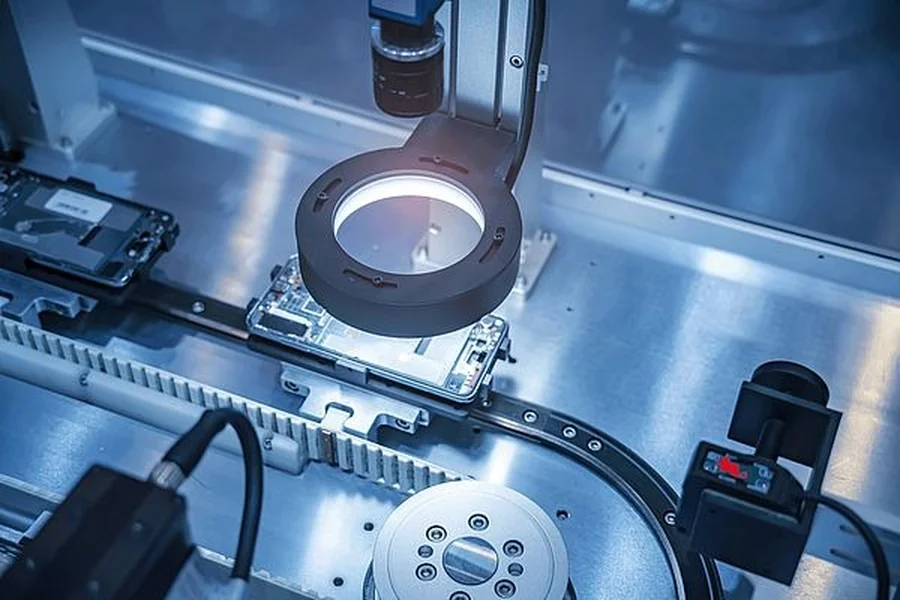
Smart factories demand inspection systems that match production speeds without sacrificing detection accuracy. Traditional quality control creates bottlenecks where products queue for manual verification, disrupting the continuous flow that defines Manufacturing 4.0 operations. Production lines running at 200-300 units per minute require automated validation that keeps pace while identifying defects measured in microns.
The integration of visual intelligence solutions bridges the gap between throughput requirements and quality standards. These systems process image data in milliseconds, making accept/reject decisions faster than mechanical sorting mechanisms can physically respond.
Edge Computing Architecture for Zero-Latency Inspection
Cloud-dependent vision systems introduce latency that disrupts high-speed manufacturing. Transmitting images to remote servers, processing them, and receiving responses back takes 150-300 milliseconds—an eternity when production lines advance 3-5 units per second.
Edge deployment positions computational power directly on the factory floor. Industrial computers equipped with GPUs sit adjacent to inspection stations, processing visual data within 20-40 milliseconds. Research from the Journal of Manufacturing Systems confirms that edge-based inspection maintains line speeds while achieving 99.2% accuracy rates.
Network dependency disappears with localized processing. Internet connectivity failures don’t halt production because inspection logic runs independently. This reliability proves critical for facilities operating 24/7 schedules where downtime costs $10,000-$50,000 per hour according to Aberdeen Group research.
Multi-Spectral Imaging Detects Invisible Defects
Standard RGB cameras capture only surface-level information. Subsurface flaws, coating inconsistencies, and material composition variations require specialized imaging techniques that extend beyond visible light spectrum.
Infrared cameras detect temperature differentials indicating internal structural problems. A study in Applied Optics demonstrated that thermal imaging identifies delamination in composite materials with 94% accuracy—defects completely invisible to standard visual inspection.
Hyperspectral systems analyze hundreds of wavelength bands simultaneously. This capability enables material verification, contamination detection, and coating thickness measurement without physical contact. The International Journal of Advanced Manufacturing Technology published findings showing hyperspectral inspection reduces material waste by 18-22% through earlier defect identification.
Integration with Industrial Control Systems
Real-time inspection delivers maximum value when connected to automated response mechanisms. Vision systems communicate directly with PLCs (Programmable Logic Controllers) through industrial protocols like OPC-UA and Ethernet/IP.
Defect detection triggers immediate actions: rejecting non-conforming parts, adjusting upstream process parameters, or halting production when defect rates exceed thresholds. This closed-loop control transforms passive inspection into active quality management.
Siemens research indicates that integrated vision-PLC systems reduce response time to quality issues from 15-20 minutes (manual detection and notification) to under 3 seconds (automated detection and correction). Faster response limits production of defective units, directly impacting scrap costs.
Training Data Generation in Production Environments
Supervised learning models require thousands of labeled examples representing each defect category. Collecting sufficient training data before deployment delays projects and increases initial costs.
Active learning approaches generate training datasets during production operation. Systems initially operate in monitoring mode, capturing images while human operators make final accept/reject decisions. These human decisions automatically label images, building robust datasets without dedicated collection efforts.
Published research in IEEE Transactions on Automation Science and Engineering shows that active learning reduces time-to-deployment by 40-50% compared to traditional pre-training approaches. Production environments provide far more diverse examples than controlled laboratory conditions, resulting in models that generalize better to real-world variations.
Performance Monitoring and Model Drift Prevention
Manufacturing processes evolve continuously through material supplier changes, equipment wear, and process optimization efforts. Static inspection models trained on historical data gradually lose accuracy as production conditions shift.
Continuous monitoring tracks key performance indicators: detection rate, false positive percentage, and confidence score distributions. Deviations from baseline metrics trigger alerts before accuracy degradation impacts production quality.
Retraining pipelines automatically incorporate new production data, keeping models synchronized with current manufacturing conditions. The Journal of Intelligent Manufacturing reports that manufacturers implementing continuous model updates maintain 95%+ accuracy over 24-month periods, compared to 75-80% accuracy for static models.
Scalability Across Production Lines and Facilities
Initial implementations typically focus on critical inspection points with highest defect rates or most expensive failure modes. Success at these pilot locations establishes technical feasibility and quantifies cost-benefit ratios.
Expansion to additional stations leverages common architectural components: camera specifications, lighting configurations, edge computing hardware, and base neural network architectures. Only defect-specific training data and final classification layers require customization for new applications.
Facilities operating multiple production lines reduce per-station implementation costs by 35-45% after the third deployment according to industry benchmarking data. Shared infrastructure, standardized mounting systems, and reusable software components drive these economies of scale.
Manufacturing 4.0 demands inspection capabilities that match the speed, precision, and connectivity of modern production systems. Real-time visual intelligence transforms quality control from a constraint into an enabler of higher throughput and reduced waste.
